Who Google AI Mode Recommends, and Who It Leaves Out
Key takeaways
- 32% of the businesses Google AI Mode recommended were nowhere in the Google Maps top 20 for the same question, and only 22% held a Maps top-three spot. An AI answer is not the map pack reshuffled.
- The businesses it recommended had a median 595 Google reviews. The ones that ranked in Maps and got no mention had 269.
- That review gap held at p = 1.1 × 10⁻¹⁰ across 995 profiles, with a 0.66 chance that a business picked at random from the recommended group has more reviews than one picked from the other.
- Businesses recommended from outside the Maps top 20 had a median 528 reviews, which puts them with the recommended group rather than the passed-over one. What gets picked follows the profile more than the ranking.
- Restaurants behaved differently. Recommended restaurants had 916 median reviews against 973 for the ones left out, a gap of nothing at all (p = 0.89).
- Reddit came up in 36% of the 50 answers and Yelp in 36%, more often than any source other than Google's own business cards.
- A typical answer recommended five businesses. That is half a map pack and a fifth of a first page of results.
What we measured, and why this design
Every piece of advice about AI visibility for local business rests on an assumption nobody has checked in public: that the businesses an AI assistant recommends are the businesses that already rank. If that holds, the advice is simple. Rank in Maps and the AI follows. If it does not hold, a business can be losing answers it should be winning, and no amount of attention to the map pack will show it.
So we tested it. Fifty questions, each one phrased the way a customer would type it. Five trades, ten cities, three city sizes. For each question we recorded two things on the same day: which businesses Google AI Mode recommended in its answer, and which businesses held the top twenty spots in Google Maps for the equivalent search.
That gives two groups drawn from the same demand, at the same moment, in the same place. Businesses the AI put forward, and businesses that ranked and got no mention. Every number below compares those two groups.
The trades are the ones where local search decides real money: dentists, personal injury lawyers, plumbers, Italian restaurants, auto repair shops. The cities are New York, Chicago and Houston at the top, Charlotte, Columbus and Sacramento in the middle, then Boise, Chattanooga, Stamford and Boca Raton at the smaller end.
Finding 1: an AI answer is not the map pack reshuffled
Of the 247 businesses Google AI Mode recommended across the fifty answers, 78 of them, very nearly a third, did not appear anywhere in the Google Maps top twenty for the same search. Not at rank four and not at rank nineteen either.
Of the 169 that did appear, the median sat at rank six, and a quarter of them were outside the Maps top ten. Across all 247, barely one in five held a top-three Maps spot.
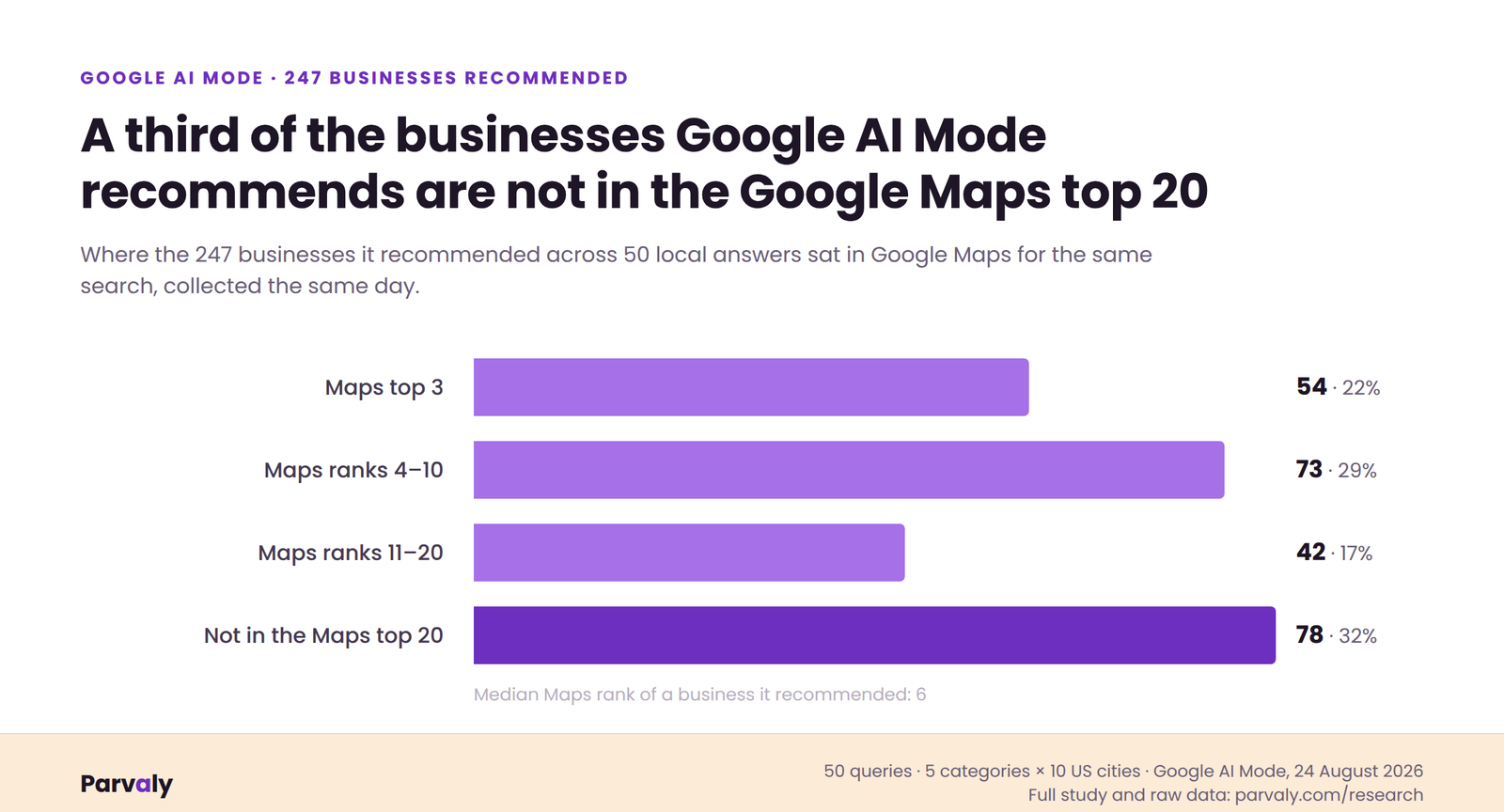
| Where the 247 recommended businesses sat in Google Maps | Count | Share |
|---|---|---|
| Maps top 3 | 54 | 22% |
| Maps top 4-10 | 73 | 29% |
| Maps top 11-20 | 42 | 17% |
| Not in the Maps top 20 at all | 78 | 32% |
If you have been checking your map pack position and reading it as your AI visibility, this is the number to sit with. The two overlap, and they are a long way from being the same thing.
Finding 2: the businesses it picks share a profile signature
The choice is not random. The two groups differ, sharply and consistently, on the attributes a business actually controls.
| Attribute (median) | Recommended | Ranked, not mentioned | Test |
|---|---|---|---|
| Google reviews | 595 | 269 | p = 1.1 × 10⁻¹⁰, A = 0.66 |
| Profile photos | 72 | 39 | p = 0.00017, A = 0.59 |
| Star rating | 4.9 | 4.8 | p = 0.0017, A = 0.58 |
| Has a website | 98% | 93% | p = 0.022 |
The A statistic is the plain-language version of the effect. Pick one business from each group at random and there is a 0.66 chance the recommended one has more reviews. That is a real separation rather than a rounding artifact of a large sample.
Two attributes are missing from that list for a reason. Publishing opening hours separated nothing, because essentially every business in the top twenty publishes hours, so it works as a floor rather than an advantage. Having a website is close to a floor too, and in only one category did it look like a lever.
Trade by trade
The pattern holds in four trades out of five, and the size of the gap swings enormously.
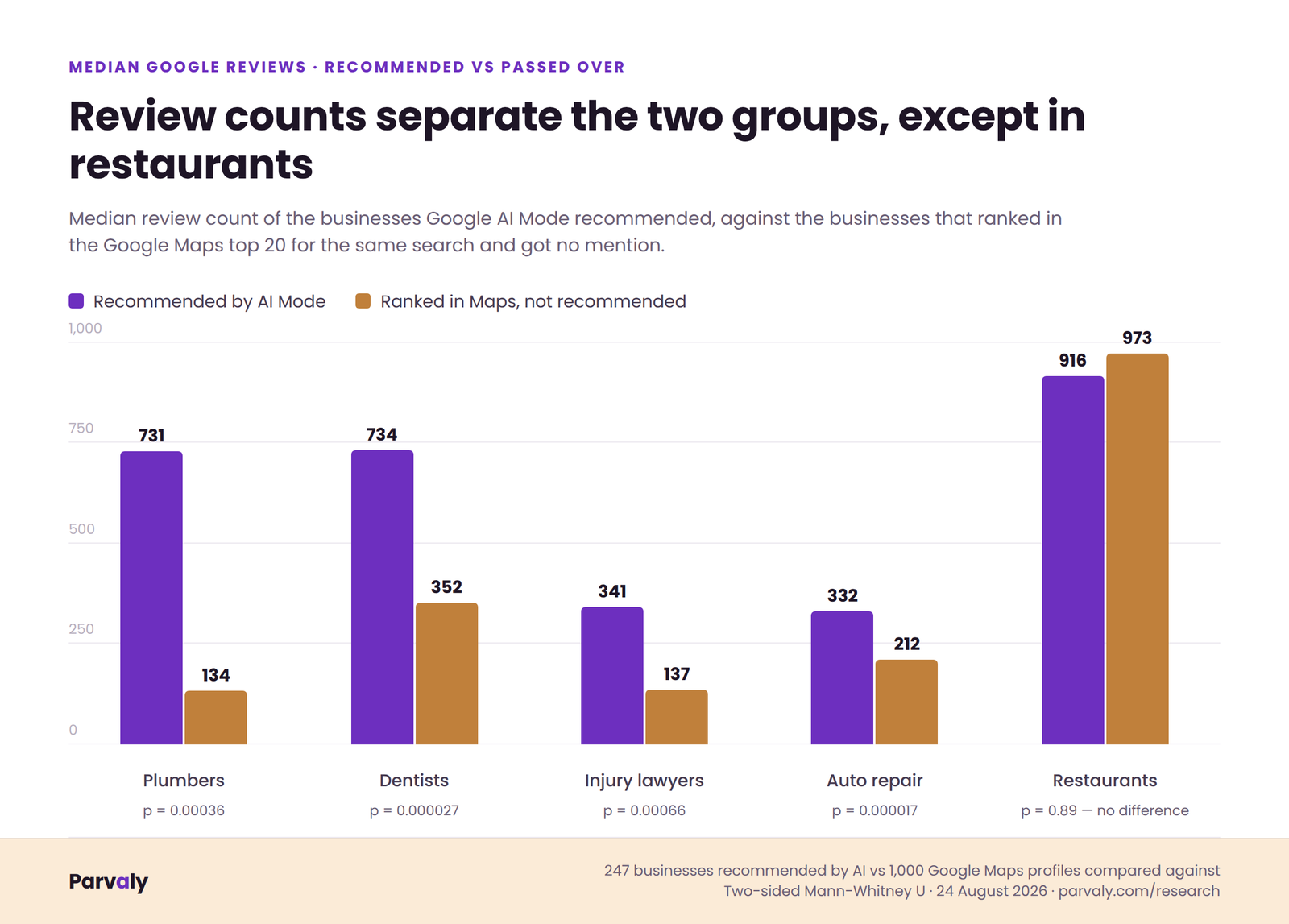
| Trade | Reviews, recommended | Reviews, not mentioned | p | Photos, recommended | Photos, not mentioned |
|---|---|---|---|---|---|
| Home services (plumbers) | 731 | 134 | 0.00036 | 119 | 51 |
| Dentists | 734 | 352 | 0.000027 | 38 | 24 |
| Law firms | 341 | 137 | 0.00066 | 38 | 23 |
| Auto repair | 332 | 212 | 0.000017 | 47 | 25 |
| Restaurants | 916 | 973 | 0.89 | 722 | 660 |
Home services shows the widest gap of all. A recommended plumber carried five and a half times the reviews of a plumber who ranked and went unmentioned. Auto repair had the narrowest gap on reviews and the cleanest separation on rating, where 4.8 against 4.7 was one of the most reliable differences we measured.
Finding 3: the ones picked from outside the map pack are not outsiders
The obvious objection to Finding 1 is that the 78 businesses recommended from outside the Maps top twenty must be marginal, a scattering of odd picks and small operations the ranking system correctly passed over.
They are not. We pulled the Google profile for each of them separately. Of the 78, 73 had a findable profile, and those profiles look like this:
| Median | Recommended, in Maps top 20 | Recommended, outside Maps top 20 | Ranked, not mentioned |
|---|---|---|---|
| Reviews | 595 | 528 | 269 |
| Rating | 4.9 | 4.8 | 4.8 |
| Photos | 72 | 66 | 39 |
| Has a website | 98% | 97% | 93% |
The businesses AI Mode reaches past the map pack to recommend look statistically indistinguishable from the ones it recommends inside it, and both are a different population from the businesses that rank and get no mention. So what gets picked follows the profile more closely than it follows the ranking. A strong profile that is not winning its map pack can still win the answer.
Finding 4: restaurants behave differently, and that matters
In restaurants, review volume did nothing. Recommended restaurants had 916 median reviews and the ones left out had 973. The test returns p = 0.89, which is a polite way of saying the two groups are the same. Photo counts did nothing either.
Star rating was the one attribute that still separated them, 4.6 against 4.5, and it did so reliably.
The reason shows up in the answers themselves. For Italian restaurants, AI Mode wrote about critics, neighborhood reputation and signature dishes, and quoted city magazines, Reddit threads and food media. For plumbers and dentists it rendered Google business cards with star ratings and review counts, then reasoned from them.
The consequence is blunt. Advice built on review volume belongs to a trade, and anyone selling it as universal has not checked. A restaurant chasing its thousandth review to win an AI answer is chasing the wrong thing. A plumber doing the same is doing exactly the right thing.
Finding 5: city size changes the strength of the effect, not its direction
| City tier | Reviews, recommended | Reviews, not mentioned | p |
|---|---|---|---|
| Large (NYC, Chicago, Houston) | 580 | 340 | 0.021 |
| Mid (Charlotte, Columbus, Sacramento) | 642 | 285 | 0.000073 |
| Small (Boise, Chattanooga, Stamford, Boca Raton) | 554 | 219 | 0.00000054 |
The separation is cleanest in small cities and weakest in the largest ones. In New York or Chicago, where hundreds of businesses clear any plausible threshold, the profile attributes stop telling anyone apart and something else decides the answer. In a smaller market the profile still does most of the work, which is good news for the businesses least able to buy their way into an answer.
One more small-city detail: every business AI Mode recommended in a small city had a website. Every single one, against 94% of the businesses that ranked and were left out. It is the only place in this data where a website looked like a lever rather than a floor.
Finding 6: what the answers quote
Across 50 answers there were 291 citations, a median of six per answer. Stripped to domains and counted by how many of the fifty answers cited each at least once:
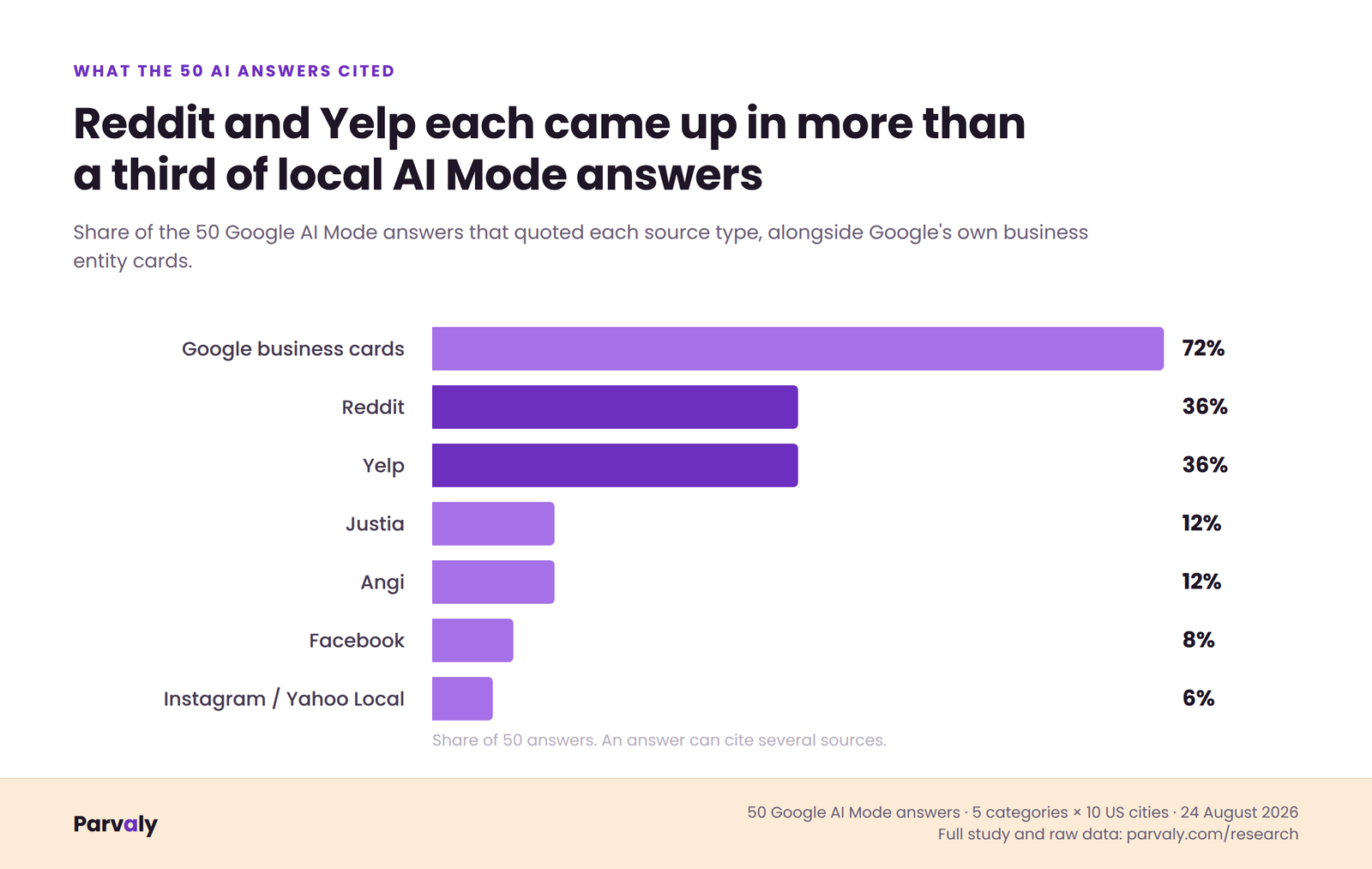
| Source | Answers citing it |
|---|---|
| Google’s own business entity cards | 72% |
| 36% | |
| Yelp | 36% |
| Justia | 12% |
| Angi | 12% |
| 8% | |
| Instagram, Yahoo Local | 6% each |
Beyond those, half of all citations went to businesses’ own sites, local media and “best of” roundups.
Reddit turning up in more than a third of local commercial answers is the number worth sitting with. It is not a directory, it cannot be optimized in the usual sense, and it cannot be bought. It is people talking, and Google is reading it back to customers who ask which plumber to call.
What a local business should take from this
Four things follow directly from the data, and one thing does not follow but is worth saying anyway.
Stop reading map pack position as AI visibility. The two come apart for a third of the businesses in this sample. Check the answer itself, in your trade and your city, and check it more than once, because the answers vary between runs.
Review volume is the strongest profile lever outside dining. The gap between the two groups is a factor of two overall and a factor of five in home services. That is not a threshold to clear. It is a direction that pays across the whole range.
Keep the profile actively maintained. Photo counts separate the groups almost as reliably as reviews do. Whether photos are the cause or simply mark a profile someone tends to, the businesses getting recommended are not the ones that filled in a profile once in 2019.
Be present where the answers look. A third of these answers quoted Reddit, a third quoted Yelp, and half of all citations went to independent sites and local roundups. Being discussed away from your own property is not a layer on top of profile work. In this data it is how a business gets recommended without ranking.
Here is what does not follow. None of this tells you that being recommended in an AI answer produced a customer. The study measures visibility, not revenue. Anyone who tells you they can convert one into the other on the strength of a correlation study is telling you something the data does not contain.
What this study does not show
Stated plainly, because a study that hides its limits deserves to be ignored.
One measurement window. All of it was collected on 24 August 2026. AI Mode answers are generated per query and vary between runs, so a repeat next month will recommend a different set. The pattern should survive. The specific businesses will not.
One question template per trade. “Who is the best dentist in {city}?” behaves differently from “emergency dentist open now near me”. Comparability across cities was bought at the cost of coverage across intents.
Correlation, not causation. Nothing here shows that adding reviews causes an AI to recommend you. Review count marks businesses that are established, busy and actively managed, and any of those could be the quality that matters.
English, United States, one surface. No ChatGPT, no Perplexity, no other country, no other language.
Matching is imperfect. Businesses were matched by normalized name within trade and city at a 0.85 similarity threshold, with the near-misses reviewed by hand. A handful of edge cases in either direction would not move the headline numbers, but they exist.
Methodology in full
Questions. Five category templates, phrased as natural questions, applied unchanged across ten cities:
| Category | Question | Maps search for the comparison group |
|---|---|---|
| Dentists | Who is the best dentist in {city}? | dentist |
| Law firms | Who is the best personal injury lawyer in {city}? | personal injury attorney |
| Home services | Who is the most reliable plumber in {city}? | plumber |
| Restaurants | What is the best Italian restaurant in {city}? | italian restaurant |
| Auto repair | What is the best auto repair shop in {city}? | auto repair shop |
Cities. Large: New York NY, Chicago IL, Houston TX. Mid: Charlotte NC, Columbus OH, Sacramento CA. Small: Boise ID, Chattanooga TN, Stamford CT, Boca Raton FL.
AI Mode collection. Each question ran through the SerpApi google_ai_mode
engine with the city set as a canonical Google location target, gl=us,
hl=en, on 24 August 2026. We captured both the structured response and the
rendered answer for every question.
Extraction. In 33 of the 50 answers, Google rendered business cards carrying name, rating, review count and address inside the answer, and those were parsed automatically. The other 17 gave their businesses in prose or in a comparison table: 12 were extracted by pattern matching on the answer’s structure and 5 were coded entirely by hand, and all 17 were checked line by line against the answer text. Names appearing only inside a quoted source snippet were not counted, because a business the assistant quotes someone else mentioning is not a business the assistant recommended.
Comparison group. The top 20 Google Maps results for each equivalent search,
collected the same day via the Outscraper Maps API with language=en and
region=US. 1,000 profiles, 998 of them unique, since two businesses surfaced
in two city searches each.
Matching. Recommended businesses were matched to comparison profiles by normalized name, lowercased with legal suffixes and punctuation stripped, within the same category and city, accepting matches at 0.85 similarity or above. Every match and every near-miss was reviewed by hand. The 78 unmatched businesses were then looked up individually to capture their profile data.
Statistics. Two-sided Mann-Whitney U tests on the unpaired groups, chosen because review and photo counts are heavily skewed and nowhere near normal. The A statistic reported alongside each p value is U divided by the product of the group sizes: the probability that a business drawn at random from the recommended group exceeds one drawn from the other. Website presence was tested with Fisher’s exact test.
The data
Everything this study rests on, published in full, because numbers without their workings are just a claim.
- Question list, with answer format and counts, 50 rows
- Businesses recommended by AI Mode, with their Maps position, 247 rows
- Maps comparison group, 1,000 rows
- Every source the answers cited, 291 rows
If you run it again and get something different, we want to know. The point of publishing the workings is that someone checks them.
Frequently asked questions
Does ranking in the Google Map Pack get my business into AI Mode answers?
Not reliably. Only 22% of the businesses AI Mode recommended in this study held a Maps top-three spot for the same question, and among those that ranked at all the median sat at rank six. Another 32% were outside the Maps top twenty completely. Ranking and getting recommended move together, but they are not the same thing, and reading one as a stand-in for the other will mislead you.
How many reviews does a local business need to be recommended by Google AI Mode?
There is no number to hit, but there is a clear gap. The businesses AI Mode recommended in this study had a median of 595 Google reviews. The ones it passed over had 269. Among plumbers the gap was widest, 731 against 134. That is a correlation from a single measurement rather than a target, though a profile with a few dozen reviews sat almost always in the passed-over group.
Why does Google AI Mode recommend businesses that do not rank in Maps?
Because it reads more than the Maps index. Reddit came up in 36% of the answers here and Yelp in 36%, and half of all citations went to business sites, local press and roundups. A business that people discuss in those places can turn up in an answer without ranking well in Maps. That happened in 78 of the 247 cases we recorded.
Do photos on a Google Business Profile affect AI visibility?
They separate the two groups, though not as sharply as reviews do. Recommended businesses had a median 72 photos against 39 for the ones passed over, and the gap held in four trades out of five. Whether the photos are why a business gets picked, or simply mark a profile that someone looks after, is not something this design can settle.
Does this study apply to restaurants?
Only partly, and that turned out to be one of the more useful things we found. Among restaurants, review counts did not separate the recommended from the passed over at all: 916 against 973, p = 0.89. Photo counts did not either. Star rating still did. For restaurants, AI Mode leaned on critics, city guides and forum threads rather than profile volume, so advice built on review counts does not carry over to that trade.
How was this measured, and can it be repeated?
Fifty questions, five trades across ten US cities, put to Google AI Mode with city-level geolocation on 24 August 2026, against the Google Maps top 20 for the same searches collected that day. The question list, the raw AI answers, the 1,000 profiles we compared against and the analysis output are published as CSVs on this page. Anyone can run it again. AI answers vary between runs, so a repeat will not return the same businesses, and it should return the same pattern.
Is being recommended by AI Mode worth pursuing for a small business?
It depends on the trade. An AI answer recommends about five businesses where a page of search results lists dozens, so each slot is scarcer and worth more. But the work that earned a slot in this data is review volume, a profile someone keeps up, and a presence in the forums and local roundups the answers quote. That is the same work that earns a Maps ranking, so it rarely needs its own budget.
Sources
- 1.Google AI Mode API · SerpApi (2026)
- 2.Top Brand Visibility Factors in ChatGPT, AI Mode, and AI Overviews (75k Brands Studied) · Ahrefs (2025)
- 3.AI features and your website · Google Search Central
- 4.Understand how Google sources & uses info in Business Profiles & local search results · Google Business Profile Help
- 5.Local Consumer Review Survey 2026 · BrightLocal (2026)
- 6.Google Maps Data API · Outscraper
Keep reading
- Generative Engine Optimization for Local BusinessHow ChatGPT, Perplexity and Google's AI answers choose which local business to name, and the work that makes yours the one they can safely recommend.
- Map Pack SEO: How to Rank in the Google Map PackMap pack SEO explained: the Google Map Pack ranking factors behind the top three local results, and the work that moves the two you can control.
- Google Business Profile Optimization: The Complete GuideEvery field on a Google Business Profile, what each one actually does for ranking, and the order to work through them, written for US small business owners.
- AI VisibilityWe make your business the one AI assistants recommend: prompt tracking, entity building and extractable content across ChatGPT, Perplexity and Google AI.
- Review ManagementFast, human responses to every review, plus a compliant system for asking happy customers to leave one: the two things that move your star rating.
Is your business showing up in AI answers?
Find out in minutes. We run your niche and city through ChatGPT, Perplexity and Google AI, then send you a report showing exactly who gets recommended instead of you.
Free. No card required.